Thursday, January 14, 2016

justICE

One of my many pet peeves is when you order a soda, watch the waiter dig the glass deep into the ice bin and fill it to the tipity top with ice. Once the glass is at the maximum capacity, they proceed to top it of with a splash of soda. The waiter proudly brings it back to the table, places the huge iceberg in front of me, all with a smile. I’m too polite to say I ordered a soda not a glass of ice, but I say it in my head, hoping they are a mind reader. I call this JustICE. What’s the big deal, it’s just ice? No, I wanted something to drink not wait a half hour to have water. 

I’m just as guilty of the “it’s just syndrome.” The other day I was working in my basement with an OCD artist friend, who is more competent than I at construction. We were cutting pipes and making pathways of electricity. I tried to help out and stay out of the way at the same time. When it was my turn to help I tried to show my competency at “somewhat” accurate measuring and straight cuts. After placing some PVC pipe in place and admiring my closeness to perfection, he commented that the pipe’s writing was facing different directions. It seems I was more worried about fitting and leaking than the aesthetics of pipes mimicking Mondrian’s Broadway Boogie. Then I said it…“Its just a basement and laundry room.” That’s when I had the epiphany of “Its just.” How many times do I say “Its just,” when to others it could be a job, a profession, or worse, a belief. 

Then I thought (It must have been the fumes from the pipe glue that made me so aware.) I never say “Its just” at my easel. Not once have I thought its just another painting, it’s ok, leave off the hand, oh don't worry about the eyes, “they’ll know who it is.” Color, composition and cropping are all thought out or intuitively right. Yes, there are mistakes made in the process, but at the end of it, it is right. The painting gets its final brush stroke of completion that says “I’m done” and it represents the closest to perfection at that moment…my signature. If I have never said “it’s just a painting”, why couldn’t I translate that sentiment in everything I do? Maybe that is something I should have put on my resolution list last week. I’ll think about it as I sip champagne. i do know one thing there is no justICE in my scotch.

Tuesday, March 17, 2015

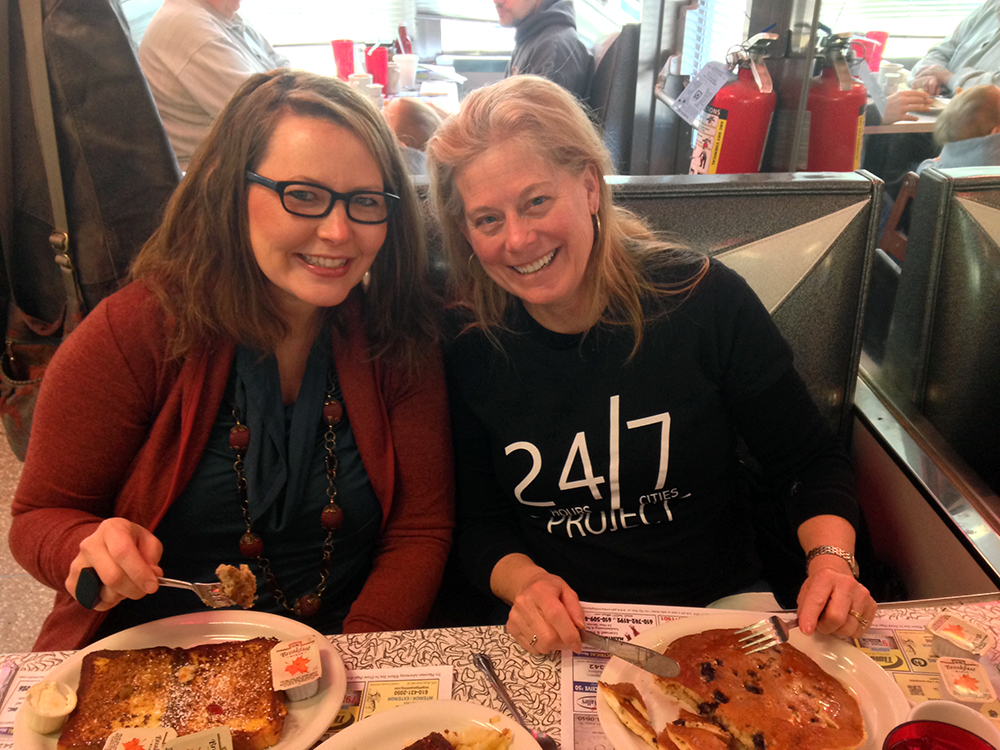
24/7 with Darcie Goldberg & Rhoda Kahler in Downingtown Diner

I began this artist interview with a home-brewed piping-hot mug filled with espresso and topped with a dollop of froth and a dash of cinnamon. However, despite this most excellent way of beginning my day, I was scared and I had good reason.
I was headed to the 24-hour diner in Downingtown where scenes from The Blob were filmed, and it should be mentioned that I am never quite sure about diner coffee. I thought the 24-hour diner would be appropriate because I was discussing a collaborative show in which two artists captured seven cities, each in 24 hours. It sounds like a recipe for a reality TV show but it’s not. It’s a well-thought out cohesive mix of talent cooked up by photographer, Darcie Goldberg, and clay artist, Rhoda Kahler.
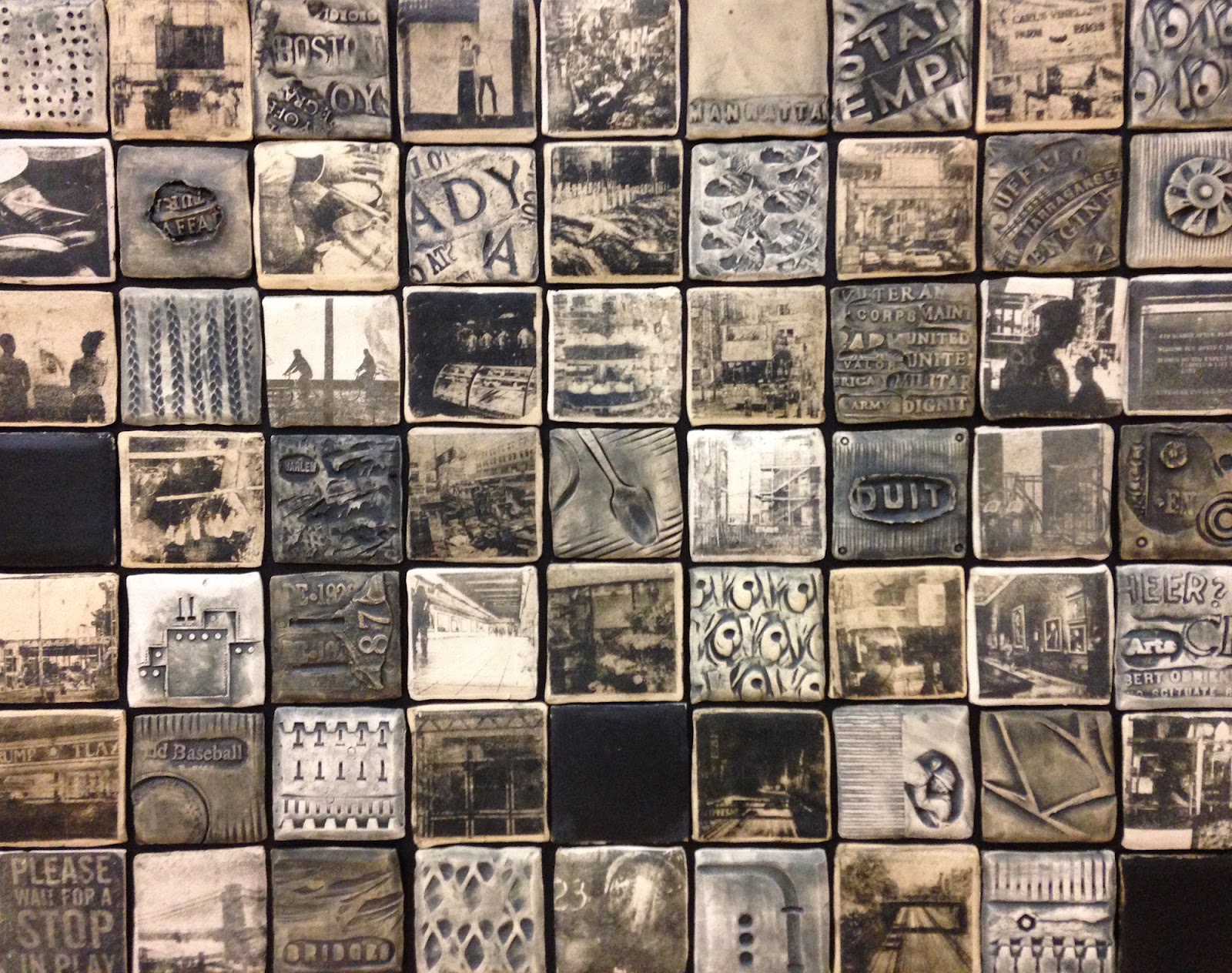
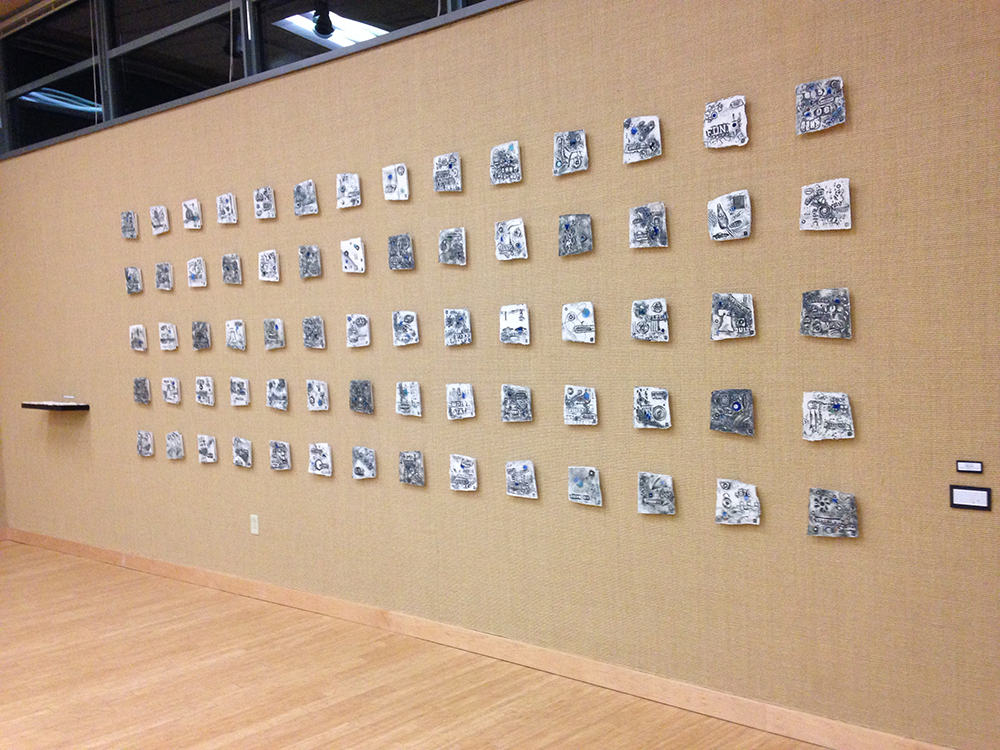
We all sat down wondering why I had scheduled this in the morning and not over a bottle of wine like my previous interviews. It didn’t take long before the hot coffee was poured and the excitement over their grandest venture bubbled out. They were like two school girls, giddy from lack of sleep and trying to finish each other’s stories, then pausing to reflect the sincere compliments coming from each other. I don’t claim to be an art critic or a food critic, so I’ll let them explain the nuances, artistic integrity and story behind a show of 1000 moments. It’s called 24/7 and it can be found at West Chester University.

Describe the concept of 24/7.
Darcie: The concept came as a collaboration, to work together, and we decided our work is very reflective of cities. Cities, right?
Rhoda: Yes.
Darcie: Then one night I was thinking about it and we decided we were going to do 24 hours in a city. I was thinking about a book, A Day in the Life of America. It was written in the ‘80s and they had 200 photojournalists from across the United States for a 24-hour period. We thought we could do it, but then I googled 24 and what came up was 24/7 so that is how it all began. The inspiration being imitation, that art is imitation but taking it into our own mediums.
How did you choose your cities?
Darcie: This took some long discussions.
Rhoda: All were easy except one.
Darcie: The I-95 corridor and how we could get there. So, locally by train and driving (laughter).
Rhoda: Darcie wanted Trenton.
Darcie: Yes I did, and Rhoda wanted Pittsburgh.
When did you start working on this project?
Rhoda: Last year we came up with the concept, but we didn’t start traveling until March. It took a while to plan it all out. You know, one of the things that was so hard for the show was that we are both so busy. It took us weeks to do each city because we would get our calendars together and we would ask each other, “Are you free this day? No. How about this day? No,” and so it took us forever.  
Darcie: Yeah, so our last city was in September.
Can you each describe your work in general for the readers?
Rhoda: Handmade ceramic tiles
Darcie: Black and white photography
Darcie, you work with photography. What were you trying to capture in the cities?
Darcie: The elements. I was also thinking about speed photography, spontaneity and looking at the city through fresh eyes. Being more of a journalist and digging deeper…I didn’t want to be a tourist. I wanted it to be more of a documentary. I had visited most of the cities before, but not on this level. You had to get off the beaten path and set a schedule. Like when we were in Philadelphia, we hit 47 places. We had a schedule, like when we went to the Free Library of Philadelphia, with the rare books.
Rhoda, you work with clay. Same question.
Rhoda: For me, it was capturing the hidden things that we don’t really see everyday, like the subway stops. I’m all about the texture, so it was capturing the details that kind of get ignored like subway platforms, rails, doorknobs. Things that are walked on and not thought about are what I like to bring attention to.
Darcie, you actually printed on clay in some of your pieces, why?

Darcie: To merge the mediums. I thought it would be a challenge.
Rhoda, did you play around with photography?
Rhoda: Only with a cell phone.
Darcie: She was great. She was the social-media queen. I was never on Facebook until Rhoda.
Rhoda: I am really appreciative that she started this because I would have never been able to do it alone. While I took pictures, I did not use my photographs. I did not print my photographs.
Darcie: Well, the photolithography was something we did jointly and I think she was very gracious in teaching me about clay. I’ve learned from her and this project would have never happened without the dynamics of Rhoda.
The show is a collaboration yet you each have your own identity. Was this hard to maintain?
Rhoda: I love that you said that! We were trying to maintain our own identity. One of my concerns with this project was exactly that. We didn’t want to lose who we were, so thank you for asking that.
Darcie: I think we did this with our signature wall.
What did you learn from each other?
Darcie: I learned dedication and about the true working artist. I would leave at about 2 or 3 in the morning and say, “OK, I need to go get some sleep!” and she would keep working until like 7 in the morning. So one day I said to her, “If you could be anything else in this world what would you be?”
Rhoda: And I said, “Absolutely nothing!” My whole life, this is what I wanted to be. I didn’t even know this until I verbalized it.
So what did you learn from Darcie?
Darcie: I learned about professionalism and she can articulate so well. I need to better articulate my thoughts and that is what she does so well. She has also taught me to stop and celebrate. It doesn’t sound like an important thing, but sometimes stopping to recognize your goals is. When I did the mural, she said, “Ok lets go out, we need to celebrate.” She enjoys the moments where I tend to work through it, and I really appreciate that.
There is a lot of art in this show  “How did you decide you were done?”
Darcie: We’re not done.
Darcie, what is your favorite piece of Rhoda’s in the show?
Darcie: I love her signature wall and all of its elements.
Rhoda, what is your favorite piece of Darcie’s?
Rhoda: I love the pieces with encaustic. They’re so rich and warm.
What city inspired you the most?
Darcie: Baltimore! I love Baltimore.
Rhoda: Well, first it was Boston and then we went to Baltimore and then we fell in love with Baltimore. We laughed through that whole city.
What was it like staying up for 24 hours?
Darcie: It was invigorating. It felt good in your soul. It felt very productive. It felt very inspirational, and then it would hit.
Rhoda: It takes days to recover from the trip.
Rumor has it you planned out your 24 hours—did you plan meals?
Certain meals. Like in Baltimore, we knew we had to get a crab cake. We got there at night so we liked that and started with a crab cake. Of course, I’m  a cannoli fiend. I had to force it on her so we had a cannoli.

The waitress continually stopped by to top off our coffee, a service I never fully understood. Why would you dilute a perfectly good combination of coffee, milk and sugar by randomly pouring more of the same liquid of which you were trying to mask the taste. Because of the mirrored interior of the standard silver-plated diner, I could see the waitress coming and would casually grab the coffee cup protecting it with my lips. But I digress. Dismissing my own personal issues, the Downingtown Diner is a fine example of a classic diner with its reflective surfaces and heaping breakfast portions.
Rhoda couldn’t resist the house special, “The Blob.” It had a little bit of everything that a “healthy” breakfast is made of: eggs, toast, hash browns and scrapple. It was so big, they brought it out on two plates. If you ever find yourself needing to soothe a queasy stomach induced from too many spirits the night before—this meal would be it! Darcie had a large stack of pancakes that looked delicious from the other side of the booth. Later comments would substantiate my observation.
I had fulfilled my personal search for excellent creamed chipped beef over toast and, of course, I opted for the over-easy egg on top. I always enjoy a plate of creamed chipped beef that isn’t overly thickened with cornstarch or flour—a breakfast product that remains in your stomach at least until dinner time. It was a perfect blend of meat and cream that didn’t make me constantly reach for my OJ to combat the saltiness. Our hot breakfast and overly caffeinated interview naturally segued to food.
How could it not? Spending 24 hours in 7 cities, one must eat.  

Who gets the most cranky when they don’t sleep?
Rhoda sheepishly raises her hand.
Who get the most cranky when they don’t eat?
There were no answers and I had to reword it so it was coffee. Then, it was decided that it was Darcie.
Your proudest moment?
Darcie: It had to be when we went to Washington D.C. to visit the gravesite of Mathew Brady, a premier portrait photographer. It was in a tough neighborhood. We rode the metro and a man came up to me as we were about to get off and told me to put my camera away, so I did. As we’re walking we see a fight and some pit bulls so again we were in a not-so-good part of town.
We get to the gravesite and I see a man with a boa constrictor around his neck coming toward us. Now, I have a phobia of snakes. I go up to him with my camera and I ask permission to take his picture. I explain what we’re doing and he tells me that when he graduated from high school, he had a scholarship to go to art school but he had no money to go. He said he loved our project and so he posed for me. It was one of those moments when you know you’re doing the right thing and that you’re at the right place. Everyone has dignity, and I wanted to capture that and show that.
Rhoda: I’m going to say it was when we got shoutouts from people who saw us wearing our 24/7 shirts. They would ask us what it was about. It was pretty cool to get recognized like that.
What were your husbands right about?
Rhoda: That we could do it. They had faith in us. Mike has been saying from the very beginning that this show was going to be great.

Darcie: We had the support at home.

What idea do you want people going away with?
Darcie: A respect for the mediums that we work with. This can happen with this medium.
Rhoda: A new view of the city.
Darcie: The collaboration—I think that is the most important thing.

Mets, Yankees, Red Soxs, Nationals or Orioles?
Rhoda: Red Sox
Darcie: The Orioles

The diner was starting to clear out and the sun was fully up. Unfortunately, we all had to get on with our day. The waitress came by to top off our coffee and disclosed some of the worst news—this wasn’t the actual diner where The Blob was filmed but merely the spot of the original diner that was in the movie. It was with grave disappointment that I realized I was no closer to Steve McQueen as he was to mentioning The Blob on his resume.

There were too many good things that came out of Darcie and Rhoda’s conversation to keep my spirits down. I was hooked. I wanted to travel and make art and bask in the creative joy these two were experiencing. I was also jealous that I hadn’t come up with this brilliant idea. It was valuable to life and to art and it needed to be shared and experienced. I’m not sure it will make good reality TV, but I do know it makes a great show, maybe even a book (hint, hint).

We can all look forward to more travels and art from them as they discussed 24/7 south and 24/7 west coast. It would be apropos if they could schedule the opening with the release of Thelma and Louise II. After breakfast with Darcie and Rhoda I realized anything is possible. As Rhoda would say, “If not you? Who? If not now? When?”

SPEED ROUND! A bunch of questions...videotaped.


Saturday, January 11, 2014

Interview with Sculptor Karen Delaney @ Terrain Restaurant


Even though we were both late for our lunch reservation at Terrain, we happened to arrive within a minute of each other. I was late because I was in search the second “B” in bring your own bottle; it was a Friday. How could one ease into the weekend with out a little celebration. My interviewee, artist Karen Delaney, on the other hand was running behind schedule because her itinerary was jam packed yet she was very well prepared because she had called ahead and made the reservation and remembered to get a bottle of wine before leaving the house. This bit of an introduction should give a little insight on the go forth, get stuff done personality of Karen. Karen is a boundless ball of energy. Her presence and determination show in her biceps. Her confidence in herself and laissez-faire attitude come across in her words. She was concerned that the interview wasn't interesting enough yet comfortable enough to tell me how much she weighs. (Now I know as a husband and male, you never ask a woman what she weighs or her age.)

Karen is a local sculptor of Chester County and the director of Chester County Art Association, but her resume reads like an old Soviet map. She studied and taught in Austria and placed large public sculptures in both Poland and Hungary. Her sculptures are architecturally inspired towers, arcs, curves and angles that hold their own space. There is not one good side to these edifices; they are all good sides. The 18 gauge steel bends to join another piece and this encounter is held and captured by molten metal. The heat from the torch dapples the edges with shades of blue and green forming tiger striped patterns along the steel’s surface. Sometimes a sphere balanced cautiously rests on a facet of the sculpture giving the sculpture a softer side, a human touch. The sphere becomes a focal point, the tension, it is the heart of the piece. But, I'm just a painter smitten by the creativity and command of space Karen possesses. Instead of me going on and on. Let's let Karen answer the questions and the wine be the truth.


INTERVIEW QUESTIONS

How did you get started making art?
I always liked decorating when I was a kid. I spent time after school working on art. My art teacher, Mr. Miller, at Ben Franklin Elementary contacted my parents and said, “You know she has interest and talent in art.” So, I always liked the art and always was building. My dad was a very hands on guy so whenever there was a house project, I was there doing it with him. So the construction part and the building part of the art that I do comes from that.

Did you receive any formal art training?
I went to Indiana University of Pennsylvania, undergraduate, and got my BFA. I worked with James Nestor who is a pretty significant sculptor in the United States and then I was supposed to go on to Rice University in Houston to get my architecture degree because I thought that was the most sensible thing to do. But I had put in an application to Radford University in Virginia and was contacted by them and was offered a teaching fellowship. I knew I didn’t want to put sculpture on the back burner; I wanted to continue to do my sculpture. So they payed me and I taught. So for the better part of that graduate education, I was able to teach undergraduates and then I had great studio space. After that I went on to graduate studies and I got my MFA.

Can you describe your work in general for the readers?
It’s predominately made of steel and architecturally influenced with a deliberate quirkiness or awkwardness to it.

What part of the art making process do you enjoy most?
The correspondence with the piece as it’s developed. My favorite part is having that conversation with the piece and noting when the best time to make decisions is. For example, when I am working on a tabletop piece, I’ll pull it in from the studio and onto my kitchen island. Then I’ll make dinner, talk to my kids or just view it as I’m walking down the stairs and I will have a gut instinct on what the piece needs. I love that point when it becomes very clear as to what it needs or if it’s not working. Then you make a change and then it speaks to you again and so on. That whole process, I thoroughly enjoy.

When did you learn to weld?
It was at The Pennsylvania Governors School For the Arts and I was 17 years old. It was a program that I wish still existed. It was a summer arts program that lasted a month; it was a scholarship thing. You had to be accepted into it and it was for the visual arts, vocal, dance, music and theater, so it was all of the arts. So, I was with hundreds of other really creative people and it was a charge to be with those other people. They broke the visual arts into groups so some would paint, some would do printmaking and some would do sculpture. So they demoed sculpture first with welding. I made a torso with scrap metal and I was hooked.

How do you do choose your subject matter?
Well I work with 18 gauge sheet metal, sometimes 16 gauge, because it is less rigid and less masculine. Steel tends to have a more masculine connotation but the way I work it, it tends to be more feminine and very soft because it’s thin metal and much more organic and reacts to heat more so it’s more fluid looking.

You use a lot of spheres in your work, why? About two years ago, I stumbled upon spheres as being interesting objects. I thought they were interesting and I actually started with wool balls. I was more fascinated by how contrasting the wool balls were with the metal. I like the play between materials but my viewers were really interested in spheres. No one could tell me why they liked them but they got a lot of reaction and so I thought there is something to this. They just became the body of my work. I don’t know if it will always be the case but they are kind of a symbol for certain things in my life.

How do you see your work impacting the viewer?
Well, working as a sculptor, you eliminate a lot of viewers. There are plenty of people who can’t respond to or do not want to respond to three dimensional work. So because of this, I feel like I narrow my audience. However, when people do connect with my sculpture, it’s usually when people see many of my works together in one space. I always get the comment that it transports them to a place. It’s like they can visualize themselves being three inches taller and walking around it, which I think is a great accomplishment because often times I’ll look at a piece and it’s sizeless. It’s like when you photograph a sculpture, it usually looks bigger than it is and when that happens I think it’s really successful. Some people say it takes them to a different place, it changes their size or it’s like being in a little village. I also get comments that my sculpture is interesting from all angles. My sculpture should be exhibited in the round because really there is no side that is necessarily more important than the others.

“How do you decide when an artwork is done?"
Sometimes, I goof that up and I do have a pile of “clinkers.” That’s exactly what I call them. They are basically scraps that are ready to be sculpture, which is good because there is a history and that makes them richer. Sometimes I overwork things. I try not to and I’m not the type to have someone in the background approving it. When I’m in full mojo, I work very smoothly but sometimes I overwork them and then I just have to be patient and sit with them for a while.

Who has been the biggest influence on your life?
My husband, John has been the biggest influence in my life and James Nestor has been the biggest influence in my art.

What inspires you?
I’m going to say, other people’s work. I love it when I see something new and it affects me. It can be a local artist or someone I see in a museum.

Do you have any habits or morning routines you do before going to the studio?
I always have to have something to drink. It could be coffee or it could be Smartwater. I also have to have rock music. It could be Metallica or just some really loud rock band. It just jumpstarts me.

What are you eating right now?
I am eating turkey and some kale with some goat cheese, which I love.

What is your favorite food? I am a big fish eater.
My natural inclination is to eat things that are healthy.

What does home mean to you?
Having comfort

Your proudest moment?
It has yet to come.

What was your father right about?
Honesty is always the best policy.

Money is OK, but it isn’t what life is about. What is it about?
It’s about satisfaction.

Where did you grow up?
Indiana, PA, it’s 50 miles east of Pittsburgh.

What is the last book you read?
I’m in the middle of Just Kids. It’s a book about Robert Maplethorpe and Patty Smith.

Something that is important on your nightstand?
My lipbalm

Your best birthday?
Camping with my family for my fortieth birthday.

FIRSTs
Big Break: I think it was going to Hungary. I have a 13 foot sculpture standing on the Danube, permanently.
Album: It was Bachman Turner Overdrive, Taking Care of Business.
Piece of art you sold: I was a masters student and it was a very organic tabletop sculpture that was made of steel and plaster.
Strangest Possession: My father made me stilts when I was 8 years old and they are painted bright blue and they are about 2 ½ feet off the ground.


I paused the art talk along with our dialogue on the local art scene to discuss the culinary
activities we were about to take part in. We sat in the old greenhouse of Jacob Styer this greenhouse once supplied cut flowers to travelers coming and going to Philadelphia. It now houses the farm to table restaurant at the ultra creative, upscale, outdoor accessory store, that is called Terrain. The best way to describe Terrain is what you would have if you had Martha Stewart, Steve Jobs, Milton Glasser and Bob Villa cleaned up the Sanford and Sons Place. It has everything that you could have probably made but didn't and they did, so you buy it, bring it home and post it on Pinterest like you did. Terrain has that NYC feel but has the comfort of Chester County and it starts with their menu. The menu reads like a grocery list. Karen decided to enjoy the rosemary honey mustard turkey breast, raw kale, brussels, dried fruit, mixed nuts, goat cheese, apple topped with a honey vinaigrette. I had the grass feed hanger salad with arugula, grilled zucchini and garlic chips…you get the idea. It was just as scrumptious as it sounds. If the portions were only as big as the descriptions, we would have been stuffed. Luckily there was room left for dessert. There was a brief conversation that maybe we should share but the dessert options were some things that I’d never make nor see again. We decided to each get one, then share so we could widen our horizons of culinary delight. In the meantime I continued to probe.

Like all good meals and insightful conversations, it must come to an end at some point. I signaled to the waitress for our check so we could finish up a day’s work. Karen was off to manage her other career as a full-time mom of three. Don't be fooled into thinking she is June Cleaver. She has been seen rocking out with her kids at concerts, cheering for them at hockey games and spending weekends camping with the family. This woman of steel doesn't rest because there is too much to do and too much to worry about. She is able to make small and tall sculpture with passion and conviction.


Don’t forget to see Karen’s answers to the speed questions along with some of her athletic ability.

Thursday, October 3, 2013

Interview with Artist Dane Tilghman at the Little Chef


I walked into Little Chef Restaurant in Coatesville, past the lunch counter to find a seat in the main dining room. I have driven by this little family restaurant many times but only noticed the retro chef guy on the sign, never thinking I would stop in for a bite. Today was different; I was stopping in for lunch to meet artist/entrepreneur Dane Tilghman. I sat down and pulled my weighty wooden chair up to the table to wait for Dane's arrival. This would be the first time I had met Dane, so I wasn't sure what to expect. He is a big guy with an inner glow that radiates out from his eyes and smile. At first glance, I would say he looks like the typical intimidating big guy but really he is as kind and courteous as a true gentleman.

More surprising was the content of his character. He possesses a deep love and passion for all that is close to his heart. A family man that found out at a young age, while working for his father, that he didn't want the “9 to 5 thing. He had his mind set on being an artist. Come what may, he was going to support his wife and two children through the brilliance of his brush. With a pallet of styles and colors, he set out to capture his family and heritage on canvas. After mastering realism, he had reached a state of boredom. Pushing himself to do better and fueled by his passion for happiness; he broke free with an elongated Cubism inspired folk art. Tilghmanʼs totally fantastic style can capture blues players and Negro baseball players and present them to the everyday common man.

I hit record on my iPhone and placed it close to Dane to capture his soft-spoken voice and allow him to tell his story.
  
How did you get started making art?
It started when I was little kid. I was probably about four years old. We were in West Chester, right at Chestnut Street. My brother, who is about a year and a half older than me, would draw and I would draw too. I just did what my brother did. (Is he still doing it?) Heck no. He gave up on it a long time ago. So thatʼs how I started and then we moved to Paoli when I was like four and a half. He went to kindergarten and I stayed home and did some drawing. Then when I went to kindergarten, I started hanging out with people who could draw other stuff. You learn that way. I was like a sponge. If you were drawing a horse, then I would draw a horse.

Did you receive any formal art training?
I went to Kutztown and got a bachelor of fine arts degree in graphic arts. Iʼll tell you what, I did not want to be a graphic designer. I went to Conestoga High School with Paul Bernhardt who was a tremendous ceramicist. He taught over at Yellow Springs. He was my teacher and he told me if you want to make a living as an artist you have to do this(graphic design) and I said ok, that makes sense, but I hated it. I got a degree in something I couldnʼt stand.

Describe your work in general.
Itʼs a...Iʼm a people person so people are the thing that I paint more than anything else. I center it around several other subject matters like music, whether itʼs Blues or Jazz or sports like Baseball. Thereʼs my what I call Everyday Man Series. I work from old black and white photography. In the beginning I was doing it in pencil and watercolor working from old photographs of my own family and relatives who have been in West Chester since 1900. I would have shows at my first gallery, Merrill Collection in West Chester, which is now in North Carolina. I would get a lot of the “old timers” come around and say, “Oh yeah, I remember her. I knew her.” That was pretty cool. I like history; I like family and I love a good story. These folks were telling me stuff that I didnʼt know about the people I was drawing at the time so it was pretty cool.

Whatʼs your medium of choice?
Right now, itʼs acrylic but like I said I started with watercolor and pencil. I started it maybe about 14 years ago. I still do pencil. I havenʼt done watercolor, I dropped it and I was really good at watercolor but it didnʼt allow me to do impressionism. I use a lot of palette knife now.

How do you choose your subject matter?
Well itʼs mostly from the black and white photography so I either go online to the Library of Congress website. Iʼve even gone down to the Library of Congress. They have a lot of black and white photographic books. I just flip through until something feels right. Thatʼs my thought process; it has to feel good. Then you start to put the picture together because sometimes a painting will have three or four different references. A little bit from here and a little bit from there so you are building a story. Sometimes a photo will tell a whole story but you arenʼt using all of the elements in the photo. Now Iʼm doing it in my elongated style.

Since you do black and white, where do you get your color palette from?
Well, from...here. Black and white, for me, is a vehicle; it gives me an image that tells a story. Color sometimes gets in the way of that story. I can feel the soul; I can connect better on almost a spiritual level to that photograph when itʼs just black and white. Once I get that story in me, then Iʼll allow the colors to come back out. I see it as a jumping off point.

What inspires you?
Again, itʼs people

Do you have any habits or routines in the morning, before you go to the easel? 
Yep, I usually get up as early as 6. I go straight to the computer. I read some books, some biblical stuff; read the Word. I would say by 9 or 9:30 Iʼm usually ready to do something related to the art business. That might be to run down to the city to take a piece of artwork to my photographer, Greg. You know that sort of thing. It varies, but when youʼre in business for yourself you have to do all of these things. I may not even get to some painting until 5 or 6 in the afternoon.

How did you develop your unique view on perspective?
It started with realism. I was really good at realism. I still am but it got boring. It was almost like I was looking to be perfect at figures and stuff. There was even a point when I stopped doing figures and was doing rocks and water and leaves. Youʼre talking some pretty complicated stuff. I was getting the reflections right and the whole prismatic thing going on and the highlights. It was fun but youʼre talking about pieces that took 125 hours to do.

What does home mean to you?
Hmmm...thatʼs an interesting question. How do you answer a question like that? My home is where my studio is; I do everything from there. Being around my kids and my wife and having my own space is like routine. I would say home is like routine.

What is your proudest moment?
My kids being born for sure

What was your mother right about?
(Laughing) Well my dad used to say, “I canʼt wait until you become a father.” Heʼd say he couldnʼt wait until we became fathers so he could sit back and laugh at us. I donʼt know how to answer the one about my mother.

Money is ok, but it isnʼt what life is about. What is it about?
Living it. Living it straight out.

Where did you grow up?
In Paoli

What was the last book you read?
Well, the Bible; I read the Word of God all of the time. Outside of that, I read a lot of self help books.

You collect?
Other artists’ artwork
  
Something that is important on your nightstand?
My earplugs

Your strangest possession?
My coin collection

At your best, you are most like this famous person?
Bill Cosby

What was the first play you saw?
For Colored Girls Who Have Considered Suicide When the Rainbow is Enuf

First big break?
It was in Gary, Indiana. I was coming back with Ros, my wife, and my daughter who was probably 3 at the time. I went out there to do an engineerʼs convention. I didnʼt make any money but on the way back, we stopped at a lawyerʼs house who I had told that I was coming to Chicago. She said, “Well since youʼre passing by Chicago give me a call and bring some new artwork.” We go to her house and she bought like 5 originals cause the show in Chicago sucked. I made like $12,000.

First album
Kool and the Gang

First concert
It might have been Kool and the Gang

First plane ride
It was in college from Washington, DC to Allentown

First piece of art you sold
A picture of a little boy on a back porch, sitting on the steps. It was done in pastel. I sold it for $25.

I had to hit pause to give Dane a chance to eat. The questions led to deeper
discussions and random tangents of shared experiences. Dane finished up his overly stuffed turkey hoagie, brimming with fresh turkey, lettuce, tomatoes and peppers. It was one of his favorites here at Little Chefʼs. He proudly stated that it was real turkey. For reasons unknown to me, I ordered the Italian sausage sandwich with peppers and onions topped with cheese; it just sounded so good. I was not disappointed. A generous sized roll that Subway might look into using soaked up the sauce while making a nice cradle for the flavor-loaded sausage. Each of the lunch entrees was priced at a modest $7.99; you can't beat it for the portions. Dane ordered another iced tea and since there was no booze to be had, I went with my standard choice, another glass of chocolate milk. I hit record and finished the questions.

Time was short, the meal was big and we both left a quarter of our sandwiches, unable to finish them. Then we headed over to his store/gallery/storage space in the heart of Coatesville. The sign read PLJC and the window read, artwork of Dane Tilghman. It was a public relations nightmare in brand identity. Once inside it all made sense. Dane is an artist and entrepreneur. We walked past rows of paintings stacked five deep against the wall near his assembly station. He showed me the die-cutter he bought to help make funeral fans. Yes he expanded his business and printed his southern folk art on the fronts of funeral fans. Back in the day he was selling thousands of them. He commented, “If you want to see something strange, go to a funeral convention.” I'll take his word on it. We walked downstairs as he told me his plans to open a restaurant in the building someday or maybe a gallery or something else. Once we reached the bottom of the stairs, he admitted that he wants to simplify his life. At 55, having made art for the past 35 years, Iʼd say this won't be easy. I stood there looking at five rows of shelving packed with prints, artwork, uncut funeral fans and much, much more. Truthfully, I wanted to stay and root through this collection of Dane's art history. It was his own unorganized retrospective. It put Al Capone's vault to shame and made Egypt's kings look poor. We headed back upstairs and once outside, he closed the door to his accomplishments behind him and headed to Philadelphia for a meeting. I didn't ask what the meeting was for; I mused that it was another big project or idea with which Dane had been blessed.

The Speed Round Question: