I began this artist interview with a home-brewed piping-hot mug filled with espresso and topped with a dollop of froth and a dash of cinnamon. However, despite this most excellent way of beginning my day, I was scared and I had good reason.
I was headed to the 24-hour diner in Downingtown where scenes from The Blob were filmed, and it should be mentioned that I am never quite sure about diner coffee. I thought the 24-hour diner would be appropriate because I was discussing a collaborative show in which two artists captured seven cities, each in 24 hours. It sounds like a recipe for a reality TV show but it’s not. It’s a well-thought out cohesive mix of talent cooked up by photographer, Darcie Goldberg, and clay artist, Rhoda Kahler.
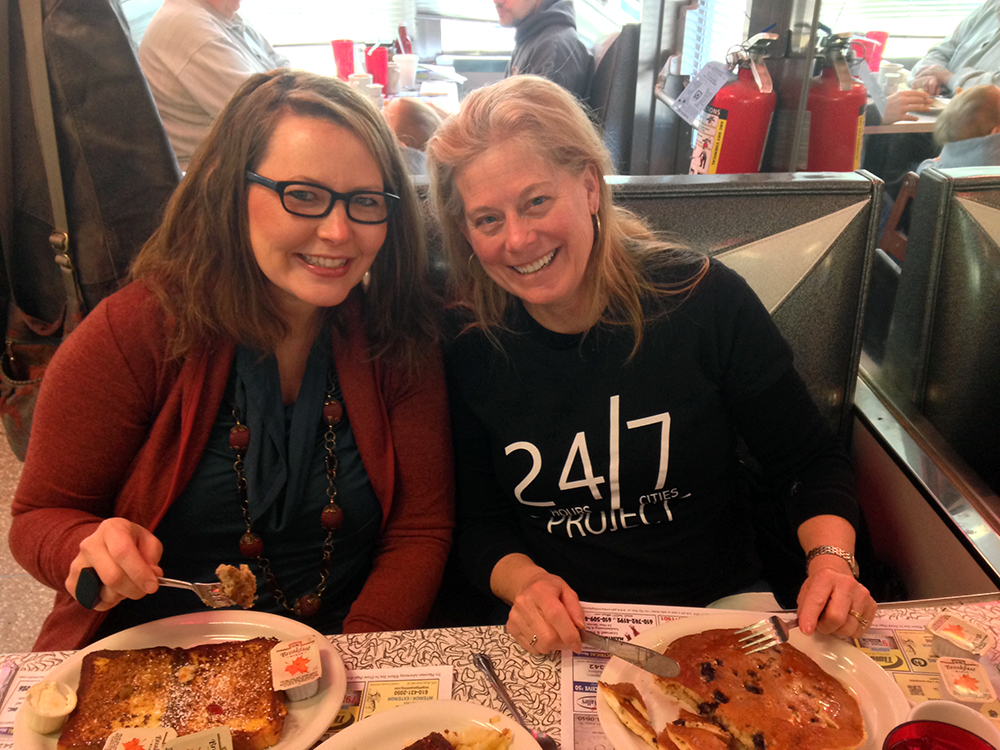
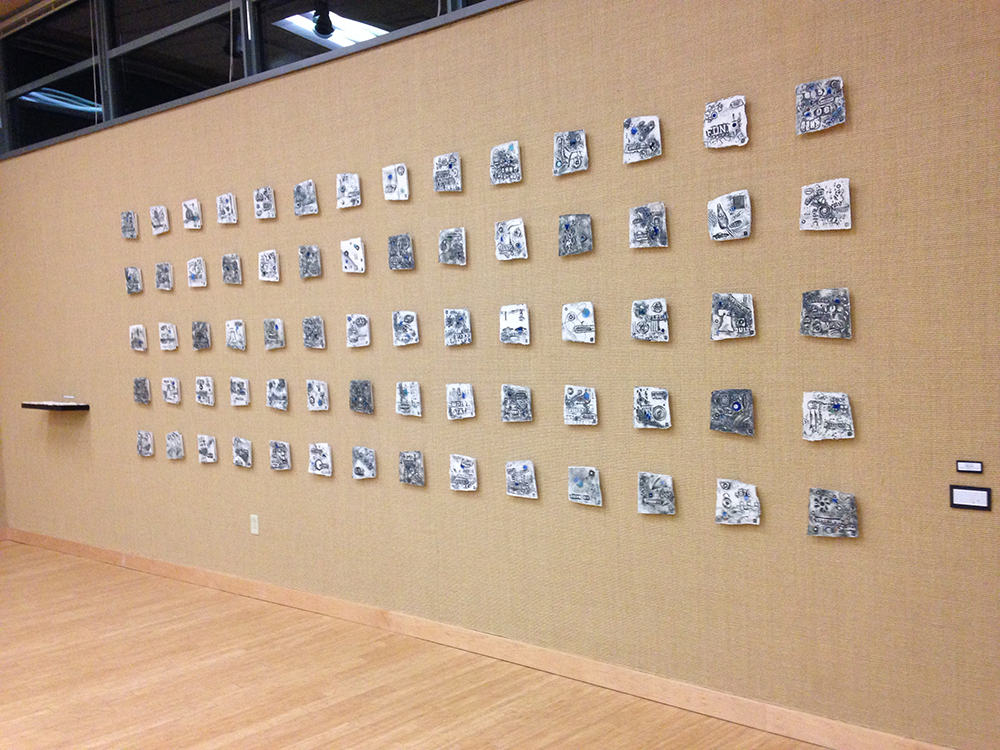
We all sat down wondering why I had scheduled this in the morning and not over a bottle of wine like my previous interviews. It didn’t take long before the hot coffee was poured and the excitement over their grandest venture bubbled out. They were like two school girls, giddy from lack of sleep and trying to finish each other’s stories, then pausing to reflect the sincere compliments coming from each other. I don’t claim to be an art critic or a food critic, so I’ll let them explain the nuances, artistic integrity and story behind a show of 1000 moments. It’s called 24/7 and it can be found at West Chester University.
Describe the concept of 24/7.
Darcie: The concept came as a collaboration, to work together, and we decided our work is very reflective of cities. Cities, right?
Rhoda: Yes.
Darcie: Then one night I was thinking about it and we decided we were going to do 24 hours in a city. I was thinking about a book, A Day in the Life of America. It was written in the ‘80s and they had 200 photojournalists from across the United States for a 24-hour period. We thought we could do it, but then I googled 24 and what came up was 24/7 so that is how it all began. The inspiration being imitation, that art is imitation but taking it into our own mediums.
How did you choose your cities?
Darcie: This took some long discussions.
Rhoda: All were easy except one.
Darcie: The I-95 corridor and how we could get there. So, locally by train and driving (laughter).
Rhoda: Darcie wanted Trenton.
Darcie: Yes I did, and Rhoda wanted Pittsburgh.
When did you start working on this project?
Rhoda: Last year we came up with the concept, but we didn’t start traveling until March. It took a while to plan it all out. You know, one of the things that was so hard for the show was that we are both so busy. It took us weeks to do each city because we would get our calendars together and we would ask each other, “Are you free this day? No. How about this day? No,” and so it took us forever.
Darcie: Yeah, so our last city was in September.
Can you each describe your work in general for the readers?
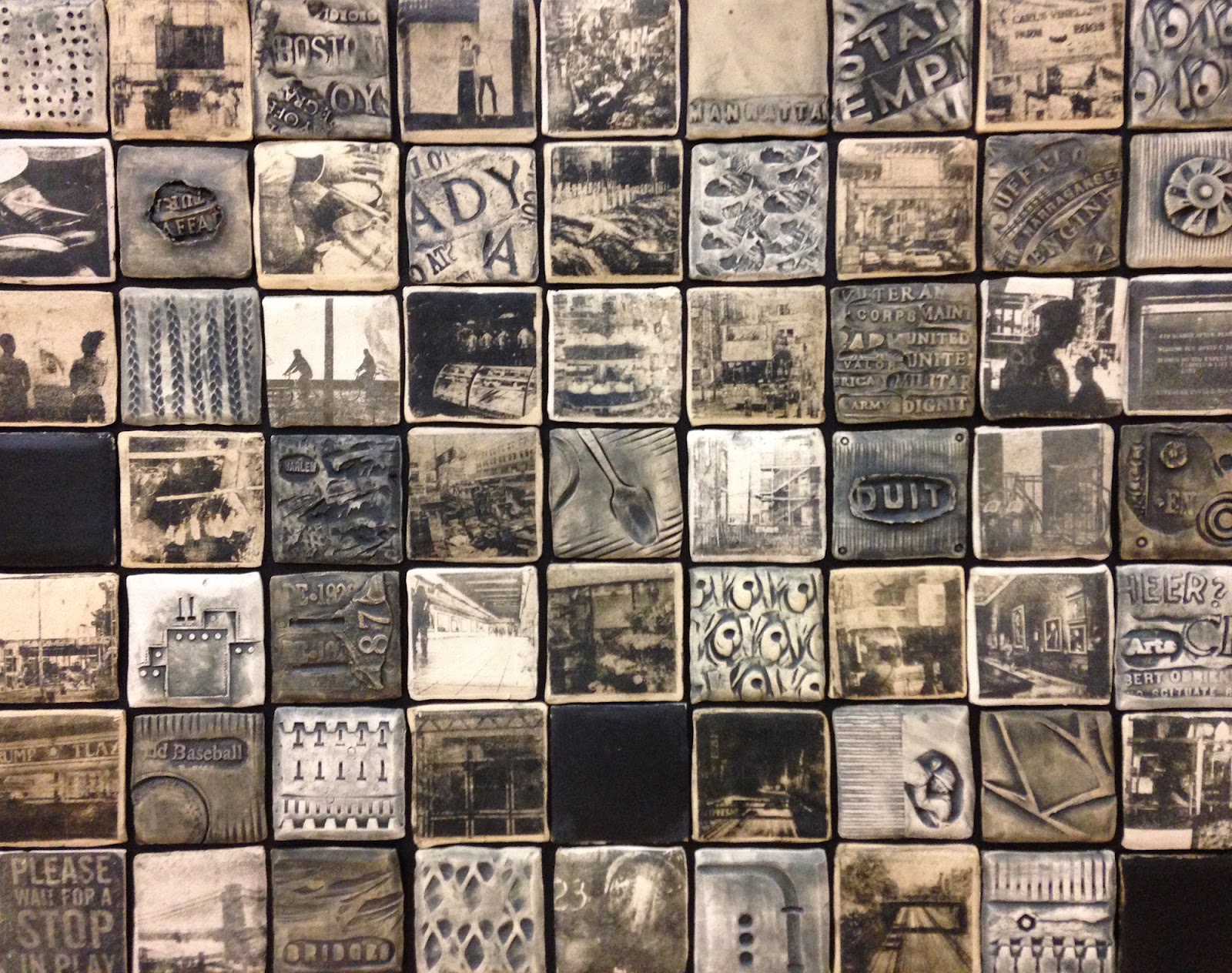
Rhoda: Handmade ceramic tiles
Darcie: Black and white photography
Darcie, you work with photography. What were you trying to capture in the cities?
Darcie: The elements. I was also thinking about speed photography, spontaneity and looking at the city through fresh eyes. Being more of a journalist and digging deeper…I didn’t want to be a tourist. I wanted it to be more of a documentary. I had visited most of the cities before, but not on this level. You had to get off the beaten path and set a schedule. Like when we were in Philadelphia, we hit 47 places. We had a schedule, like when we went to the Free Library of Philadelphia, with the rare books.
Rhoda, you work with clay. Same question.
Rhoda: For me, it was capturing the hidden things that we don’t really see everyday, like the subway stops. I’m all about the texture, so it was capturing the details that kind of get ignored like subway platforms, rails, doorknobs. Things that are walked on and not thought about are what I like to bring attention to.
Darcie, you actually printed on clay in some of your pieces, why?
Darcie: To merge the mediums. I thought it would be a challenge.
Rhoda, did you play around with photography?
Rhoda: Only with a cell phone.
Darcie: She was great. She was the social-media queen. I was never on Facebook until Rhoda.
Rhoda: I am really appreciative that she started this because I would have never been able to do it alone. While I took pictures, I did not use my photographs. I did not print my photographs.
Darcie: Well, the photolithography was something we did jointly and I think she was very gracious in teaching me about clay. I’ve learned from her and this project would have never happened without the dynamics of Rhoda.
The show is a collaboration yet you each have your own identity. Was this hard to maintain?
Rhoda: I love that you said that! We were trying to maintain our own identity. One of my concerns with this project was exactly that. We didn’t want to lose who we were, so thank you for asking that.
Darcie: I think we did this with our signature wall.
What did you learn from each other?
Darcie: I learned dedication and about the true working artist. I would leave at about 2 or 3 in the morning and say, “OK, I need to go get some sleep!” and she would keep working until like 7 in the morning. So one day I said to her, “If you could be anything else in this world what would you be?”
Rhoda: And I said, “Absolutely nothing!” My whole life, this is what I wanted to be. I didn’t even know this until I verbalized it.
So what did you learn from Darcie?
Darcie: I learned about professionalism and she can articulate so well. I need to better articulate my thoughts and that is what she does so well. She has also taught me to stop and celebrate. It doesn’t sound like an important thing, but sometimes stopping to recognize your goals is. When I did the mural, she said, “Ok lets go out, we need to celebrate.” She enjoys the moments where I tend to work through it, and I really appreciate that.
There is a lot of art in this show “How did you decide you were done?”
Darcie: We’re not done.
Darcie, what is your favorite piece of Rhoda’s in the show?
Darcie: I love her signature wall and all of its elements.
Rhoda, what is your favorite piece of Darcie’s?
Rhoda: I love the pieces with encaustic. They’re so rich and warm.
What city inspired you the most?
Darcie: Baltimore! I love Baltimore.
Rhoda: Well, first it was Boston and then we went to Baltimore and then we fell in love with Baltimore. We laughed through that whole city.
What was it like staying up for 24 hours?
Darcie: It was invigorating. It felt good in your soul. It felt very productive. It felt very inspirational, and then it would hit.
Rhoda: It takes days to recover from the trip.
Rumor has it you planned out your 24 hours—did you plan meals?
Certain meals. Like in Baltimore, we knew we had to get a crab cake. We got there at night so we liked that and started with a crab cake. Of course, I’m a cannoli fiend. I had to force it on her so we had a cannoli.
The waitress continually stopped by to top off our coffee, a service I never fully understood. Why would you dilute a perfectly good combination of coffee, milk and sugar by randomly pouring more of the same liquid of which you were trying to mask the taste. Because of the mirrored interior of the standard silver-plated diner, I could see the waitress coming and would casually grab the coffee cup protecting it with my lips. But I digress. Dismissing my own personal issues, the Downingtown Diner is a fine example of a classic diner with its reflective surfaces and heaping breakfast portions.
Rhoda couldn’t resist the house special, “The Blob.” It had a little bit of everything that a “healthy” breakfast is made of: eggs, toast, hash browns and scrapple. It was so big, they brought it out on two plates. If you ever find yourself needing to soothe a queasy stomach induced from too many spirits the night before—this meal would be it! Darcie had a large stack of pancakes that looked delicious from the other side of the booth. Later comments would substantiate my observation.
I had fulfilled my personal search for excellent creamed chipped beef over toast and, of course, I opted for the over-easy egg on top. I always enjoy a plate of creamed chipped beef that isn’t overly thickened with cornstarch or flour—a breakfast product that remains in your stomach at least until dinner time. It was a perfect blend of meat and cream that didn’t make me constantly reach for my OJ to combat the saltiness. Our hot breakfast and overly caffeinated interview naturally segued to food.
How could it not? Spending 24 hours in 7 cities, one must eat.
Who gets the most cranky when they don’t sleep?
Rhoda sheepishly raises her hand.
Who get the most cranky when they don’t eat?
There were no answers and I had to reword it so it was coffee. Then, it was decided that it was Darcie.
Your proudest moment?
Darcie: It had to be when we went to Washington D.C. to visit the gravesite of Mathew Brady, a premier portrait photographer. It was in a tough neighborhood. We rode the metro and a man came up to me as we were about to get off and told me to put my camera away, so I did. As we’re walking we see a fight and some pit bulls so again we were in a not-so-good part of town.
We get to the gravesite and I see a man with a boa constrictor around his neck coming toward us. Now, I have a phobia of snakes. I go up to him with my camera and I ask permission to take his picture. I explain what we’re doing and he tells me that when he graduated from high school, he had a scholarship to go to art school but he had no money to go. He said he loved our project and so he posed for me. It was one of those moments when you know you’re doing the right thing and that you’re at the right place. Everyone has dignity, and I wanted to capture that and show that.
Rhoda: I’m going to say it was when we got shoutouts from people who saw us wearing our 24/7 shirts. They would ask us what it was about. It was pretty cool to get recognized like that.
What were your husbands right about?
Rhoda: That we could do it. They had faith in us. Mike has been saying from the very beginning that this show was going to be great.
Darcie: We had the support at home.
What idea do you want people going away with?
Darcie: A respect for the mediums that we work with. This can happen with this medium.
Rhoda: A new view of the city.
Darcie: The collaboration—I think that is the most important thing.
Mets, Yankees, Red Soxs, Nationals or Orioles?
Rhoda: Red Sox
Darcie: The Orioles
The diner was starting to clear out and the sun was fully up. Unfortunately, we all had to get on with our day. The waitress came by to top off our coffee and disclosed some of the worst news—this wasn’t the actual diner where The Blob was filmed but merely the spot of the original diner that was in the movie. It was with grave disappointment that I realized I was no closer to Steve McQueen as he was to mentioning The Blob on his resume.
There were too many good things that came out of Darcie and Rhoda’s conversation to keep my spirits down. I was hooked. I wanted to travel and make art and bask in the creative joy these two were experiencing. I was also jealous that I hadn’t come up with this brilliant idea. It was valuable to life and to art and it needed to be shared and experienced. I’m not sure it will make good reality TV, but I do know it makes a great show, maybe even a book (hint, hint).
We can all look forward to more travels and art from them as they discussed 24/7 south and 24/7 west coast. It would be apropos if they could schedule the opening with the release of Thelma and Louise II. After breakfast with Darcie and Rhoda I realized anything is possible. As Rhoda would say, “If not you? Who? If not now? When?”
SPEED ROUND! A bunch of questions...videotaped.

